Consent gets all the attention in every DPDP Act conversation, but the reality is that the Act expects far more than a simple accept button. What appears to be a single user action is actually an entire operational system that organizations must build, maintain, and prove. Before we look at what the DPDP Act requires, it helps to understand why consent has become one of the most misunderstood parts of compliance.
1. What people think the DPDP Act requires
When most people discuss the DPDP Act, they speak only about consent. They imagine a user tapping an agree button and assume the organization has fulfilled its responsibility. However, the DPDP Act and the DPDP Rules twenty twenty-five make it clear that consent is only the beginning. The law expects a complete consent ecosystem that includes multi language notices, itemized purposes, smooth withdrawals, strong logging, and clear evidence of every action. These requirements are written directly in the notified DPDP Rules.
2. The gap between what organizations think and what the DPDP Act actually requires
Many organizations believe that updating their privacy banner or refreshing their consent notice is enough. In reality, the Act demands much more. Consent must be understandable for all users, purpose specific, easy to withdraw, and supported by detailed logs that remain intact for at least a year. None of this is optional. These are enforceable obligations under the DPDP Act and the DPDP Rules.
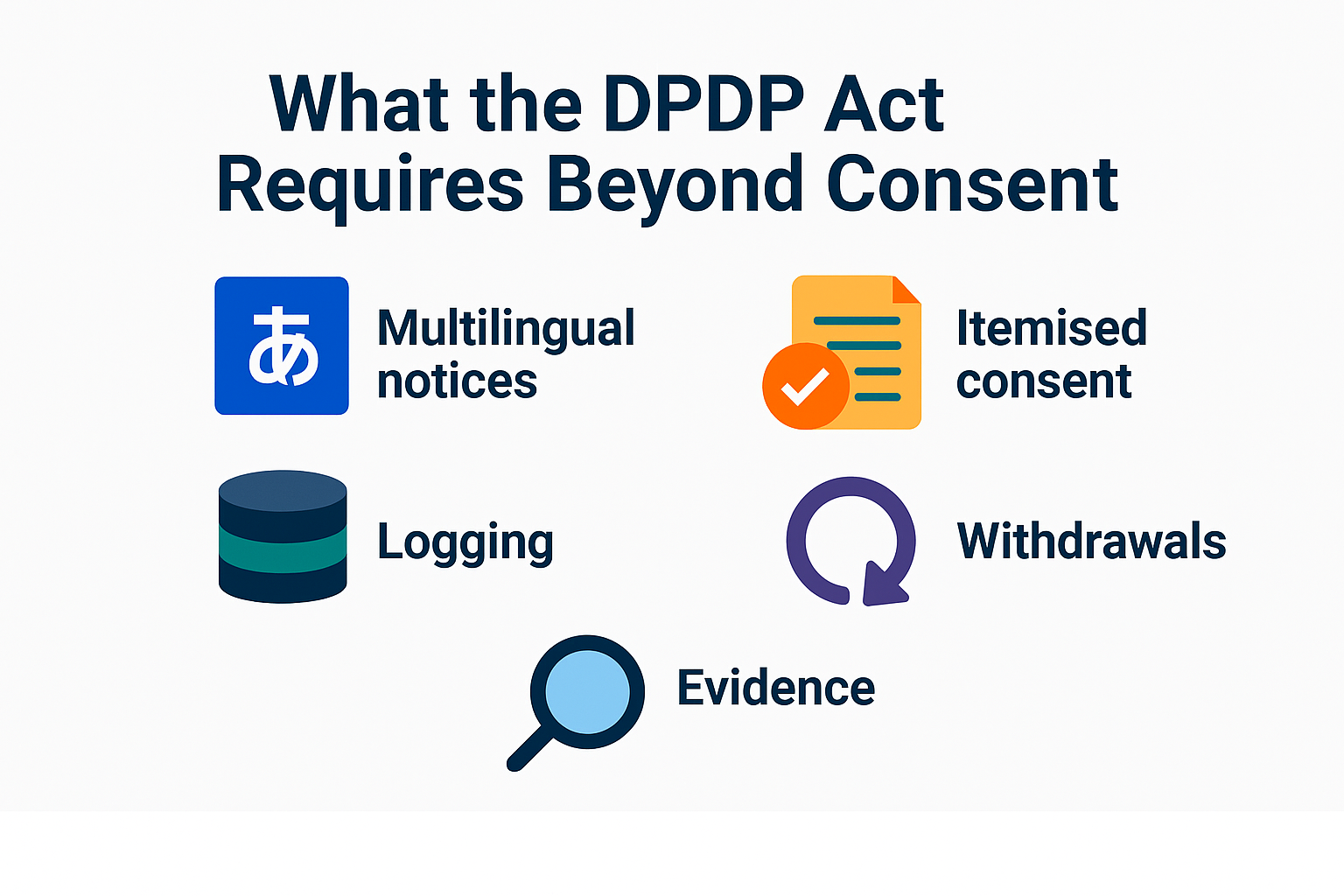 3. The Real Pillars of DPDP Act Consent
Multi language notices are now mandatory
The DPDP Rules require notices to be available in all twenty-two scheduled Indian languages. This is not a minor change. It represents a major shift in how organizations communicate. Every notice must be clear, accurate, and updated consistently in each language. Whenever the English version changes, all other versions must change as well. This moves transparency from a design preference to a compliance responsibility.
Itemized consent is replacing bundled approvals
The Act does not allow bundled permissions. It requires itemized and standalone notices where every purpose is explained separately. If an organization processes data for analytics, marketing, or service improvement, each purpose must be clearly presented and individually agreed to. This forces organizations to analyze their processing activities closely and build consent systems that can store and act on purpose wise approvals.
Withdrawals must be as easy as giving consent
The DPDP Rules require that users must be able to withdraw consent just as easily as they give it. Once a withdrawal is made, organizations must stop processing immediately. They must update internal systems, notify vendors, and ensure that the user does not face any disadvantage. This is often the hardest requirement to implement because many systems were not built to support reversibility. Yet the DPDP Act makes withdrawal a core user right.
Logging is now a core control, not an optional extra
Organizations must maintain detailed logs for at least one year. These logs must include the notice shown, the language used, the selected purpose, the timestamp of consent, the withdrawal record, and all related system changes. Without logs, there is no way to prove that consent was collected correctly or that a withdrawal was honored. Logging is the backbone of accountability.
Evidence is the foundation of compliance
The DPDP Act repeats one message. If you cannot prove it, it does not count. The Rules require evidence for consent, withdrawal, erasure requests, breach reporting, and technical safeguards. This shifts compliance away from policy writing and toward real, traceable action. The law rewards organizations that can show verifiable records, not just intentions.
4. Why This Matters for Organizations
Consent under the DPDP Act is not a front-end feature. It is a complete end to end system that connects notices, backend logic, vendor management, logs, records, and evidence. Organizations that treat consent as a checkbox will struggle. Those that treat it as an operational discipline will be prepared when scrutiny arrives.
This matters because users have rights. They can give consent, review it, withdraw it, and expect that their choices will be respected throughout the entire data lifecycle. The DPDP Act turns these expectations into enforceable responsibilities.
5. The DPDP Act Demands A Complete Consent System
Everyone is talking about consent, but the DPDP Act demands much more.
It demands:
- multi language notices for transparency
- itemized consent for clarity
- easy withdrawals for user control
- comprehensive logging for accountability
- strong evidence for compliance
Consent is not a single moment, it is a continuous process that must work for every user, in every language, across every system. When organizations understand this shift, they stop designing for compliance and start designing for trust.