The compliance gap most companies do not see When organizations prepare for the Digital Personal Data Protection Act, one of the biggest challenges they overlook is vendor risk under the DPDP Act. Most teams start by reviewing internal processes. They update privacy policies, redesign consent notices, and examine how their own systems collect and process personal data, but one of the biggest compliance risks often sits outside the organization.
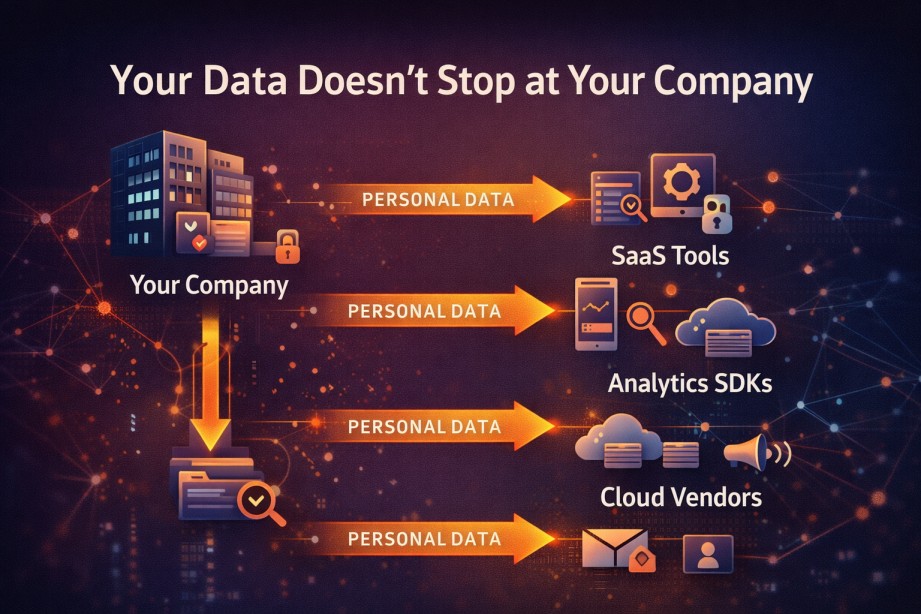
Most companies today rely on a wide network of external tools. Marketing platforms track user behaviour. Cloud vendors store application data. Analytics SDKs capture activity across websites and apps. SaaS tools process employee and customer information every day. In many cases, these tools operate quietly in the background. Teams integrate them quickly to support business needs, without fully examining how personal data moves through those systems.
This creates a major compliance gap. Under the DPDP Act, organizations remain responsible for the personal data they collect and process, even when that data passes through third party services.
The Invisible flow of Personal Data through Vendors
Modern digital businesses depend heavily on third party technology. A typical website or mobile application may connect to dozens of external services at the same time. This is why vendor risk under the DPDP Act is becoming one of the most important compliance challenges for modern organizations.
A marketing team may use a platform to send campaigns. Product teams may rely on analytics tools to study user behaviour. Customer support systems often store communication histories and account information. Each of these tools processes personal data in some way. However, organizations rarely have complete visibility into how that data flows between systems. Data may move from a website to a marketing tool, then to an analytics platform, and eventually into a cloud database.
These complex data flows make governance difficult. Without clear visibility, organizations may struggle to understand where personal data actually exists. Our article “Data Visibility Under the DPDP Act: Challenges & Compliance” explores this challenge in greater detail.
When data moves across multiple vendors, it becomes harder to enforce privacy principles such as purpose limitation, data minimization, and retention control.
Why Vendor Risk Under the DPDP Act Makes Companies Accountable?
A common misunderstanding in privacy compliance is the belief that responsibility shifts to the vendor once data leaves the organization. In reality, most privacy laws take the opposite approach, organizations that determine the purpose and means of processing personal data remain accountable for how that data is handled. This means a company can still face regulatory scrutiny even if the issue originates in a third-party system. Vendor risk under the DPDP Act means organizations must remain accountable even when personal data is processed by external platforms or service providers.
Guidance from the International Association of Privacy Professionals IAPP often highlights this principle. Organizations must ensure that vendors follow appropriate data protection practices when handling personal information. The DPDP Act follows a similar philosophy, companies must implement reasonable safeguards to protect personal data. Those safeguards do not stop at the boundaries of the organization.
If a vendor misuses data, stores it insecurely, or processes it for unintended purposes, the impact may still fall on the organization that originally collected the data.
How SaaS ecosystems complicate privacy compliance
SaaS platforms have transformed how companies build digital services. They allow organizations to deploy powerful tools without developing everything internally. However, the convenience of SaaS also introduces risk.
Many SaaS tools automatically collect large volumes of behavioral and technical data. Analytics platforms track user interactions. Marketing tools build detailed customer profiles. Customer experience software records conversations and usage patterns.
Over time, these tools can accumulate more personal data than organizations actually need, this situation can conflict with important privacy principles. For example, collecting excessive information may challenge data minimization requirements. Storing data indefinitely may also conflict with retention obligations.
Our article Why DPDP Act Will Fail Without Purpose Limitation: The One Control Most Companies Ignore explains why clearly defining the purpose of data processing is essential for responsible data practices.
Why vendor risk may shape early DPDP enforcement
As regulators begin focusing on the practical implementation of privacy laws, third party relationships often become a key area of scrutiny. Vendor relationships create several potential risks.
First, organizations may not fully understand how vendors process personal data. Second, contracts may not clearly define data protection responsibilities. Third, companies may not regularly review whether vendors still meet security and privacy expectations. These gaps can create compliance vulnerabilities, even when companies build strong internal privacy programs, weak oversight of third-party systems can undermine those efforts.
Building stronger vendor accountability
Managing vendor risk does not require eliminating external tools. Most modern businesses depend on them. Instead, organizations must build stronger oversight practices.
Before integrating a new vendor, teams should understand what personal data the service will collect and why it is needed. Privacy and security teams should also review how the vendor protects that data. Regular vendor assessments help ensure that data protection practices remain consistent over time. Organizations should also document how personal data moves between their systems and external services.
These steps create stronger visibility and accountability.
A simple question every company should ask:
Vendor ecosystems will continue to grow as organizations adopt more digital tools. With each integration, the flow of personal data becomes more complex. The DPDP Act encourages organizations to move beyond policies and think carefully about how data is actually handled in practice.
Sometimes, the most important compliance question is also the simplest one. When personal data flows through multiple systems and vendors, organizations should pause and ask:
Do we truly understand where this data is going and why it is being processed?
Answering that question clearly may become one of the most important steps in building responsible privacy practices under the DPDP Act.