When organizations discuss the Digital Personal Data Protection Act, the conversation often revolves around consent, privacy notices, and user rights. However, DPDP Act security safeguards may become one of the most important areas of compliance. While policies and documentation matter, regulators often focus on whether organizations have actually implemented strong technical and operational protections for personal data.
That section is Section 8, which requires organizations to implement reasonable security safeguards to protect personal data.
Unlike policy-based requirements, security safeguards are operational. They affect how systems are built, how access is controlled, how data is monitored, and how incidents are handled. Because these controls are visible during investigations and audits, regulators often examine them closely when something goes wrong. This is why many privacy experts believe DPDP Act security safeguards may become one of the most actively enforced areas of the DPDP framework.
Why DPDP Act Security Safeguards Matter for Regulators
Across global privacy enforcement trends, many regulatory penalties originate from basic security failures rather than complex legal interpretations. In several cases, organizations faced regulatory action for relatively simple mistakes such as sending sensitive information through unencrypted communication channels or failing to restrict internal access to personal data.
These incidents reveal a clear pattern. When regulators investigate a breach or data exposure, they often begin with a straightforward question: Did the organization take reasonable steps to protect the personal data it collected?
If the answer is unclear or cannot be supported by technical controls, enforcement actions become more likely. This focus on technical safeguards is reflected in global privacy enforcement trends and regulatory guidance around data protection practices. For example, discussions around security safeguards in privacy governance are frequently highlighted by the International Association of Privacy Professionals IAPP, which analyzes enforcement cases and compliance expectations across jurisdictions.
For organizations preparing for the DPDP Act, this trend highlights an important shift. Compliance is not only about policies and documentation. It is also about the strength of the operational controls that protect personal data.
A simple way to understand where most security failures actually happen:
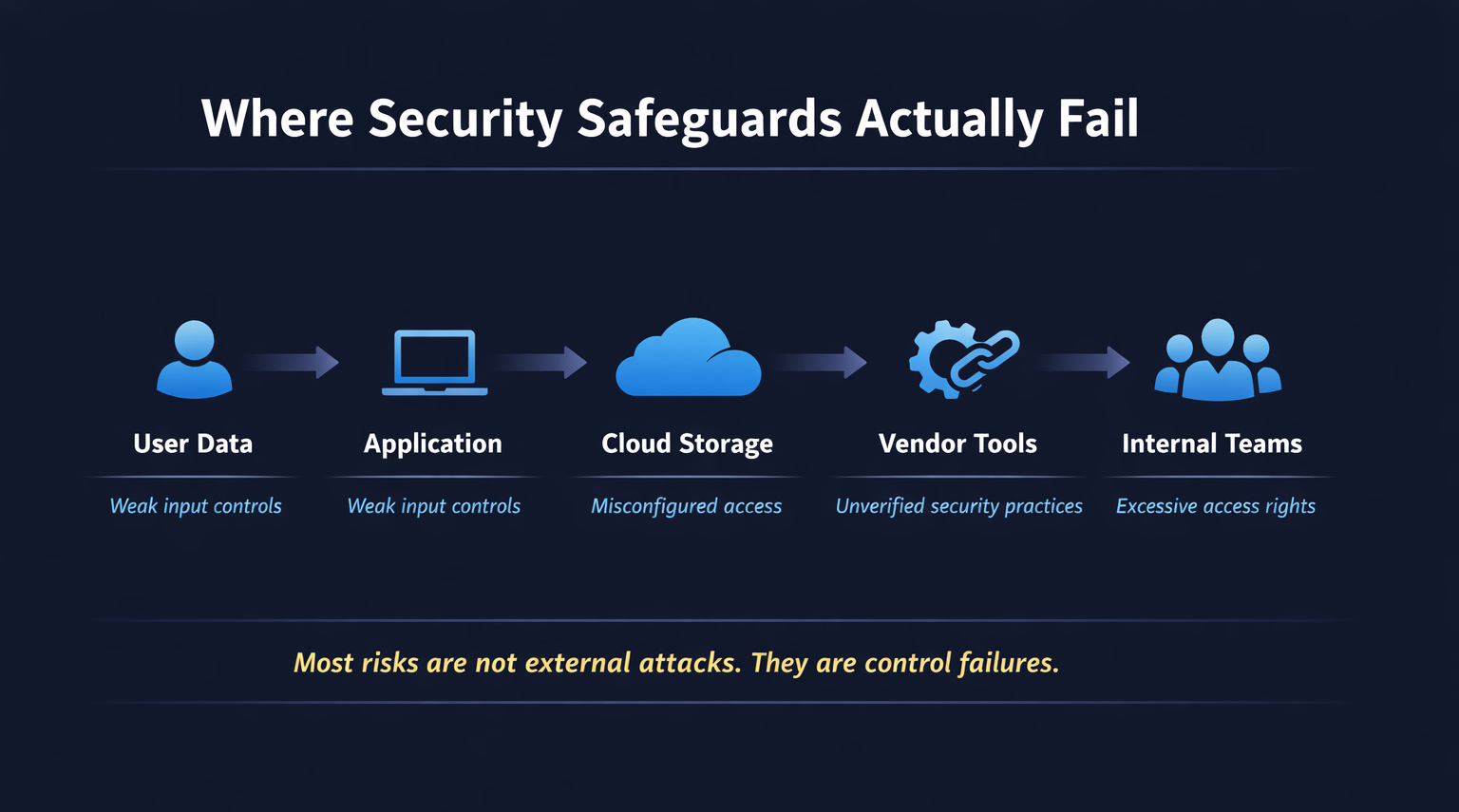
Most security risks in DPDP compliance arise from internal control gaps rather than external attacks.
Misconfigured cloud environments
Many modern organizations rely on cloud infrastructure to store and process large volumes of personal data. Cloud platforms provide flexibility and scalability, but they also introduce new security responsibilities.
Misconfigured storage systems are one of the most common causes of data exposure worldwide. A database that lacks proper access restrictions can unintentionally allow external access to personal data. Sometimes these exposures occur simply because default security settings were never reviewed. When personal data becomes accessible due to configuration errors, regulators may view the situation as a failure to implement adequate safeguards.
Section 8 encourages organizations to adopt a proactive approach to cloud security. Regular configuration reviews and automated monitoring can help detect potential exposures before they become incidents.
Excessive access rights inside organizations
Security risks do not always originate from external attackers. In many cases, they begin inside the organization itself. Employees across different departments often need access to systems that store personal data. However, when access permissions expand over time without proper review, too many individuals may gain access to sensitive information.
This situation creates unnecessary risk. Even if employees act responsibly, excessive access increases the likelihood of accidental disclosure or misuse. Applying the principle of least privilege helps reduce this risk. Each user should only have access to the information necessary for their specific role.
Clear access governance not only improves security but also demonstrates accountability during regulatory reviews.
Why testing and monitoring matter?
Security safeguards cannot rely only on initial system design. Systems change frequently as organizations introduce new features, applications, and integrations.
Without regular testing, hidden weaknesses can remain undetected for long periods. Security assessments, penetration testing, and vulnerability reviews help identify weaknesses before attackers or regulators discover them.
Monitoring also plays a critical role. Logging systems record how personal data is accessed and used across digital environments. When organizations maintain reliable logs, they can quickly investigate unusual activity and respond effectively.
Without logging and monitoring, even well-designed systems can become difficult to audit.
Preparing for data breaches before they happen
No organization can eliminate every security risk. Even well-protected systems may eventually face incidents. What regulators often examine is how prepared the organization was before the breach occurred.
Incident response planning helps organizations respond quickly when security issues arise. Clear procedures for detection, containment, investigation, and communication can significantly reduce the impact of an incident. Preparation also demonstrates that the organization takes data protection responsibilities seriously.
Vendor systems as part of the security perimeter
Another critical area involves third-party vendors. Many organizations rely on external platforms for analytics, marketing, customer management, and cloud storage. These services process personal data on behalf of the organization, which means their security practices also affect compliance.
If a vendor system fails to protect personal data, regulators may still hold the organization responsible for inadequate safeguards.
Our article DPDP Act and Vendor Accountability: Why Third-Party Risk Will Be India’s First Real Compliance Crisis explores how vendor ecosystems can create hidden compliance risks.
Organizations must therefore review vendor security practices, assess risks before integrating new tools, and maintain oversight over how external services process personal data.
Security safeguards are the foundation of trust
The DPDP Act introduces several important privacy rights and obligations. However, many of those protections rely on one fundamental requirement.
Personal data must be protected through effective technical and organizational safeguards. Without those safeguards, policies and consent mechanisms provide little practical protection. Organizations that invest in security governance will not only reduce regulatory risk but also build stronger trust with customers and users.
Our article Why DPDP Act Will Fail Without Purpose Limitation: The One Control Most Companies Ignore explains how defining the purpose of data processing strengthens privacy governance. Strong DPDP Act security safeguards ensure that personal data remains protected throughout its lifecycle.
As organizations prepare for the DPDP framework, Section 8 serves as a reminder that privacy compliance is not only about legal documentation. It is also about how securely personal data is handled every day across systems, teams, and technologies.