Under India’s Digital Personal Data Protection Act, 2023 (DPDP Act), consent is no longer a static legal formality. It is a continuous, auditable lifecycle that must be actively managed, validated, updated, renewed, and withdrawn.
The Consent Management System (CMS) Business Requirement Document clearly establishes that compliance cannot be achieved through one-time consent collection. Instead, organizations must implement a full consent lifecycle framework that ensures transparency, user control, and accountability at every stage.
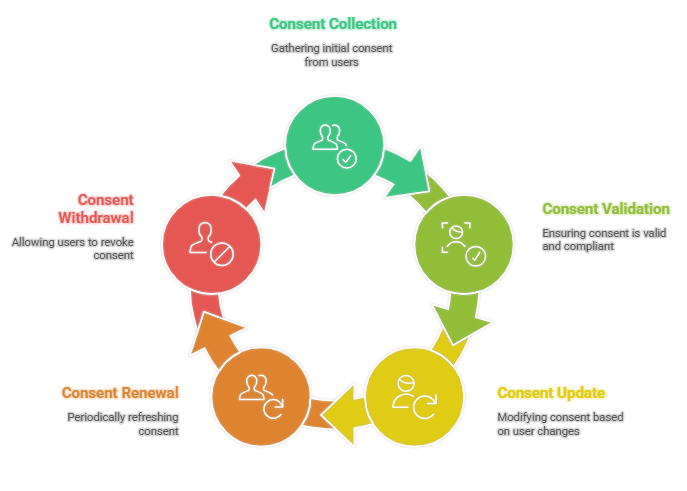
The lifecycle begins with consent collection, which forms the legal foundation for all subsequent data processing. Under the DPDP framework, consent must be free, specific, informed, unconditional, and unambiguous, and the CMS enforces these requirements through purpose-specific and granular consent mechanisms. Individuals are presented with clear notices explaining why their data is being collected, what categories of data are involved, how long the data will be retained, and how they can exercise their rights. Crucially, the system prevents bundled consent by separating mandatory purposes from optional ones such as marketing or analytics. Consent is captured only through an explicit affirmative action, and once provided, it is transformed into a secure consent artifact containing metadata such as the user identifier, purpose identifiers, timestamp, language preference, and consent status. This artifact becomes the authoritative record for compliance and audit purposes.
Once consent is collected, it cannot be assumed to remain valid indefinitely or across all activities. This is where consent validation becomes essential. Before any personal data is processed whether for service delivery, analytics, or communication the CMS validates the consent in real time. Validation confirms that consent exists for the specific purpose, that it is active and not expired or withdrawn, and that the intended processing does not exceed the scope originally agreed to by the individual. By enforcing validation through system APIs before processing begins, the CMS ensures that unlawful or unauthorized data use is technically blocked, not merely discouraged by policy. Every validation attempt, whether successful or denied, is logged to create a verifiable compliance trail.
Over time, processing purposes may change, expand, or evolve, and the DPDP Act makes it clear that consent cannot be silently extended to cover such changes. The consent update stage addresses this reality. When a new purpose is introduced or an existing purpose is modified, individuals must be informed clearly about what has changed and how it affects their data. The CMS allows users to update their consent preferences on a per-purpose basis, ensuring that previously granted consents remain intact unless explicitly modified. Updated consent always requires an active user decision and results in an updated consent artifact with fresh metadata. This stage reinforces the principle that consent is contextual and must adapt transparently to changes in data usage.
In many cases, consent is granted for a limited duration, either by design or by regulatory expectation. The consent renewal stage ensures that data processing does not continue on the basis of stale or expired permissions. As consent approaches its expiration, the CMS proactively notifies individuals and provides a simple, intuitive mechanism to renew their consent if they choose to do so. Renewal is treated as a fresh affirmative act, not an automatic extension, and renewed consent is recorded with a new timestamp and validity period. This approach ensures that ongoing processing always rests on current and demonstrable user intent.
The final and most powerful stage of the lifecycle is consent withdrawal, which embodies the DPDP Act’s emphasis on individual control. Individuals must be able to withdraw consent as easily as they gave it, and the CMS ensures that withdrawal can be performed for specific purposes without affecting others. Once a withdrawal request is confirmed, the system immediately updates the consent status, notifies all connected data fiduciaries and processors, and triggers the cessation of processing for the withdrawn purpose. The individual receives confirmation along with information about any service impacts resulting from the withdrawal. While certain legal obligations may require limited continued retention or processing, such exceptions are explicitly handled and documented. Every withdrawal action is immutably logged, ensuring that the organization can demonstrate compliance beyond doubt.