
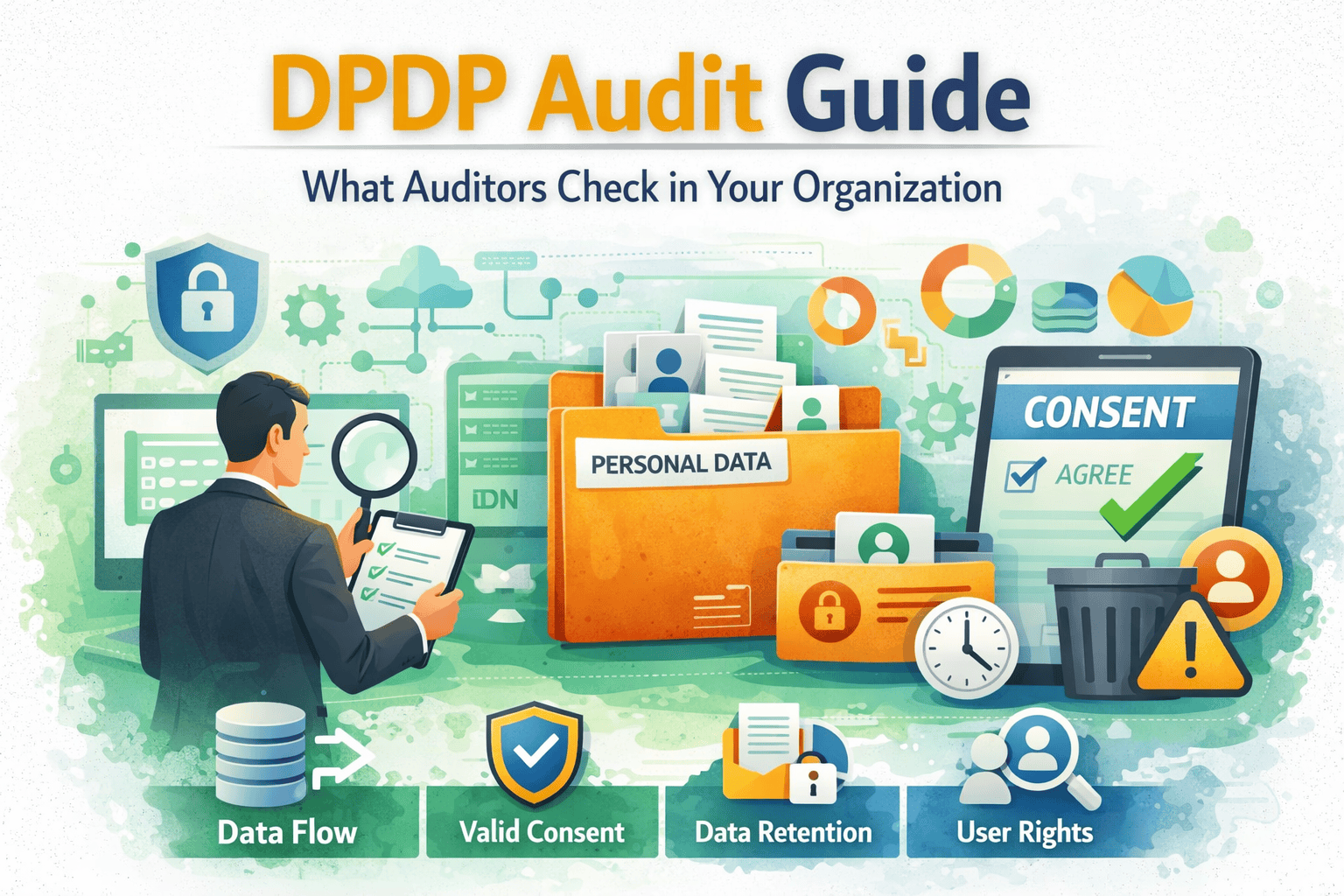
A visual overview of what auditors check during a DPDP audit, including data flow, consent, retention, and user rights handling
Most organizations today believe they are on the path to compliance, but a DPDP audit is where that belief is truly tested. Policies are drafted, consent banners are implemented, and teams assume they are moving in the right direction, but compliance is not proven during planning.
A DPDP audit is not just a checklist exercise. It is a deep look into how your organization actually handles personal data across systems, teams, and everyday operations.
Let’s walk through what this audit would realistically look like inside your company.
Step 1: The First Question Is Always Simple
Almost every audit begins with a deceptively simple question:
“What personal data do you collect and why?”
At first, this feels like something any team can answer quickly. But once you start digging deeper, the complexity becomes clear.
Different departments collect data for different purposes. Marketing teams gather lead information through forms and campaigns. Product teams collect behavioral data to improve user experience. Customer support teams store conversations, tickets, and user history.
The challenge is not collection. The challenge is visibility.
Most organizations do not have a single, unified view of all the personal data they collect. Information exists in silos, spread across tools, platforms, and teams. As a result, answers become partial, inconsistent, or unclear.
This is where many audits begin to expose the first gap. If you cannot clearly define what data you collect and why, everything that follows becomes difficult to justify.
Step 2: Show Me Where the Data Lives
Once you define the data you collect, the next step is understanding where it actually exists.
An auditor will not stop at definitions. They will ask you to map your data.
They will want to know:
- Where is the data stored across your systems
- Which tools or platforms process it
- Whether it moves between internal systems or external vendors
In modern organizations, data rarely stays in one place. It flows between CRM tools, analytics platforms, cloud storage, support systems, and third-party integrations.
Over time, these flows become complex and often invisible.
Without proper documentation, organizations lose track of how data moves. This creates blind spots that can lead to compliance risks.
This is exactly why data discovery plays such a critical role in DPDP readiness. You can explore this further in our guide on DPDP Act Data Discovery Will Decide DPDP Readiness, Not Privacy Policies
Step 3: Prove You Have Valid Consent
After mapping data, the audit moves to one of the most critical areas.
Consent.
The question here is simple but powerful:
“Can you prove that you have valid consent for the data you collect?”
Many organizations assume that having a checkbox or a banner is enough. But compliance goes much deeper than that.
You need to demonstrate:
- What the user was told at the time of giving consent
- Whether the consent was clear, specific, and informed
- When and how the consent was captured
- Whether users had a real choice
Consent is not just a user action. It is a record that must stand up to scrutiny.
If your consent logs are incomplete, scattered, or difficult to retrieve, it becomes a serious issue during an audit. For a broader understanding of how consent is interpreted globally, you can refer to the European Commission’s data protection framework: https://commission.europa.eu/law/law-topic/data-protection_en
Step 4: What Happens After Collection
Collecting data is only the starting point. What truly matters is what happens next. Auditors will want to understand how personal data is used across your organization.
They may ask:
“Once you collect this data, what do you actually do with it?”
This question touches multiple layers of your operations.
They will evaluate:
- How the data is used in business processes
- Who has access to it and why
- Whether access is limited based on roles and responsibilities
- How usage is monitored and controlled
In many companies, access to data grows over time without proper review. Employees, tools, and teams continue to gain access, often beyond what is necessary and his increases the risk of misuse, both intentional and accidental.
Strong internal controls, clear ownership, and defined processes are essential to demonstrate that data is handled responsibly after collection.
Step 5: Can You Handle User Rights Requests
One of the most practical tests in a DPDP audit is how well you handle user rights.
Auditors may simulate or directly ask:
“If a user requests access to their data or asks for deletion, what happens next?”
This is where theory meets execution.
You need to show that you can:
- Identify and locate the user’s data across all systems
- Process the request within a reasonable timeframe
- Ensure that the requested action, such as deletion or correction, is completed everywhere
In many organizations, this process is still manual. Teams rely on multiple systems, emails, and coordination across departments, and this creates delays, inconsistencies, and a higher chance of error.
You can explore this challenge in detail in our blog on DPDP Act Rights Handling: The Hardest Part of Readiness
Step 6: Are You Retaining Data Longer Than Needed
Another important area auditors focus on is data retention.
The key question here is:
“How long do you keep personal data, and why?”
Many organizations define why they collect data but fail to define when they should delete it.
Over time, data accumulates. Old records remain in systems long after their purpose is fulfilled. This not only increases storage costs but also expands the risk surface.
Auditors will look for clear answers:
- Do you have defined retention policies
- Are these policies actually implemented in your systems
- Is data deleted once it is no longer required
Retention is often overlooked because it does not create immediate problems but during an audit, it becomes a visible and measurable gap.
Step 7: What Happens If Something Goes Wrong
No system is completely immune to failure and that is why audits also focus on how organizations respond to incidents.
The question here is direct:
“What happens if there is a data breach or misuse of personal data?”
Auditors will assess your preparedness by looking at:
- Whether you have a defined incident response process
- How quickly issues are identified and reported
- What steps are taken to contain and resolve the situation
They are not expecting perfection. They are looking for readiness.
Organizations that acknowledge risks and prepare for them tend to perform better than those that assume nothing will go wrong.
The Reality Most Companies Face
When organizations prepare for audits, they often focus on documentation.
Policies are written. Frameworks are designed. Processes are outlined.
But audits do not evaluate intentions. They evaluate reality.
Common gaps that surface include:
- Limited visibility into actual data flows
- Inconsistent or incomplete consent records
- Lack of coordination between teams handling data
- Delays in responding to user requests
- Retention policies that exist on paper but not in practice
These gaps are not unusual. They are the result of growing systems without structured data governance.
Final Thought
A DPDP audit is not about finding faults. It is about understanding how your organization truly handles personal data and it brings clarity to what is working and what is not.
The organizations that succeed are not the ones with the most documentation. They are the ones that have clear visibility, strong processes, and consistent execution.
If you can confidently answer simple questions about your data, your systems, and your decisions, you are already in a strong position.
If not, this is the right time to start building that clarity before the audit does it for you.